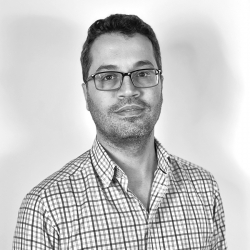
Bio
I am a Research Scientist at the Gran Sasso Science Institute (GSSI), Italy,
working on the foundations of automated program analysis. My research develops
formal and algorithmic frameworks for automated program repair, fault interaction,
and software verification — with a particular focus on settings where classical
single-fault assumptions break down and standard correctness guarantees no longer
hold. My work has appeared in leading software engineering venues including
ICSE, ASE, TOSEM, SANER, ICSME, FASE, JSS, and ACM TECS.
I earned my Ph.D. in Computer Science from the University of Western Australia,
an M.Sc. from the University of New South Wales, and a B.Sc. in Computer
Engineering from Jordan University of Science and Technology. Prior to GSSI,
I held research positions at Simula Research Laboratory (Norway), the
National University of Singapore, and Nanyang Technological University —
collaborating across the software engineering and formal verification communities.
Research
Modern software systems are increasingly analyzed, verified, and repaired
using automated reasoning techniques. Most of these techniques, however,
rely on simplifying assumptions about program behavior, fault independence,
or algorithmic decidability that often fail in realistic software. My
research develops the formal and algorithmic foundations needed to reason
about these limitations, combining software engineering, formal methods,
and program analysis to build techniques that are both theoretically sound
and practically applicable.
Theme 1: Foundations of Interaction-Aware Software Engineering
Software faults rarely occur in isolation. Their interactions, including
masking, cascading, and synergistic effects, can fundamentally alter program
behavior and challenge conventional approaches to testing, debugging,
verification, automated repair, and fault localization. My research
develops formal foundations for fault interaction and translates
them into interaction-aware techniques for symbolic execution, program
analysis, verification, fuzzing, and automated program repair. The
long-term objective is to establish a unified foundation for software
engineering in which analysis and repair explicitly account for interacting
faults rather than assuming their independence.
Theme 2: Foundations of Automated Reasoning and Decidability
My second research direction investigates the theoretical limits of
automated software reasoning. I study how computability, formal
verification, symbolic reasoning, termination analysis, and program
semantics shape what automated techniques can guarantee. This includes
establishing formal limits such as the undecidability of repair
overfitting, developing verification-aware reasoning frameworks, and
integrating semantic properties—including correctness, termination, and
performance—into automated analysis and synthesis. The broader goal is to
design software engineering methods whose guarantees are explicitly aligned
with the underlying theory of computation.
These two threads feed into a broader, long-term research agenda — a living
collection of open problems spanning multi-fault software engineering,
automated program repair, symbolic execution, software verification, fuzzing,
and the theoretical foundations of automated software reasoning, motivating
future work and potential collaborations.
Collaborators
My research spans the software engineering and formal methods communities, with active collaborations across both.
I welcome opportunities to collaborate with researchers and highly motivated
students on challenging problems in software engineering, formal methods,
program analysis, software verification, automated program repair,
symbolic execution, software testing, and related areas.